What If the New Tax Does Not Pass and Fresnans Keep $65 Million in Their Pockets?
Before Fresno replaces Measure C with a general tax, voters deserve the complete financial record.
Drive through almost any older Fresno neighborhood and the pavement tells its own story.
Cracked streets. Potholes. Uneven pavement. Broken sidewalks. Curbs that have waited decades for repair.
Potholes do not have a political party. Broken sidewalks are neither Republican nor Democrat. Families and business owners do not want another political explanation. They want results.
That is why Fresno’s proposed new half-cent sales tax should not be about politics. It should be about performance, priorities, accountability and results.
The question is not whether Fresno needs better roads, sidewalks and public transportation.
It does. The real question is whether Fresno voters should approve a new half-cent general sales tax expected to raise approximately $65 million every year, when the revenue would go into the General Fund with no legally binding percentage requiring that it be spent on roads, sidewalks, transit or transportation matching funds.
The City Council voted on July 30, 2026, to place the measure before voters.
Before another $65 million a year is collected, Fresno taxpayers deserve an answer to one fundamental question: What happened to the Measure C money Fresno already had?
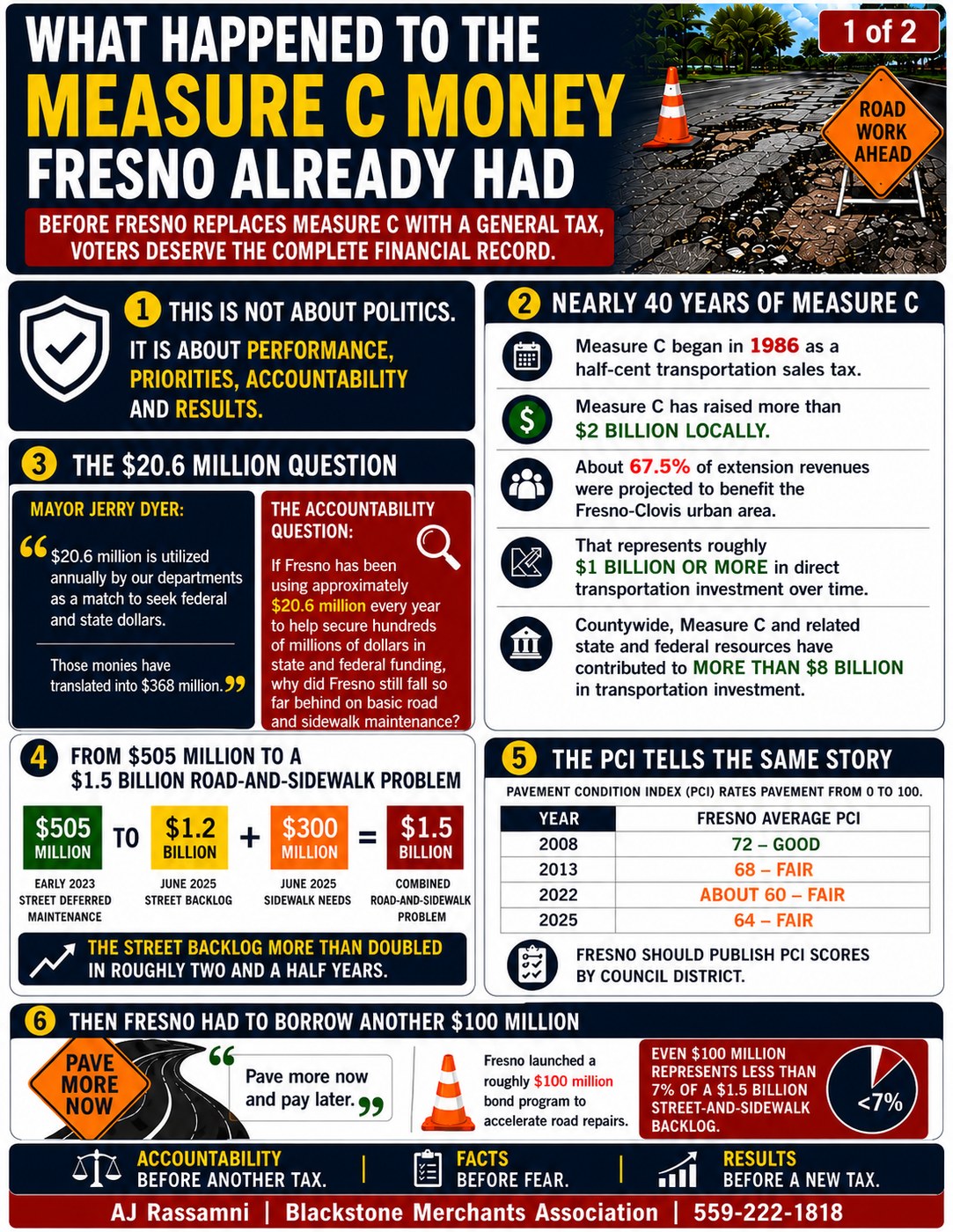
Nearly 40 Years of Measure C
Fresno County voters approved Measure C in 1986 as a half-cent transportation sales tax. Voters approved another 20-year extension in 2006, which expires June 30, 2027. Measure C therefore had a defined life and a defined transportation purpose.
According to the Fresno County Transportation Authority, Measure C has raised more than $2 billion locally over its history. The 2006 Measure C expenditure plan projected that approximately 67.5% of extension revenues would be spent in the Fresno-Clovis urban area or within the Fresno and Clovis spheres of influence.
That represents roughly $1 billion or more in direct and regional Measure C transportation investment benefiting the Fresno urban area.
In addition, Measure C has helped Fresno leverage substantial state and federal transportation funding. Countywide, Measure C and related state and federal resources have contributed to more than $8 billion in transportation investment. That is an enormous amount of money and it leads to the next question.
The $20.6 Million Question
At the July 30, 2026, City Council meeting, Mayor Jerry Dyer explained what he described as one of the biggest consequences of losing Measure C.
He said:
“$20.6 million is utilized annually by our departments as a match to seek federal and state dollars.”
He then added:
“Those monies have translated into $368 million.”
That is impressive financial leverage. But it creates perhaps the most important accountability question in this entire debate: If Fresno has been using approximately $20.6 million every year to help secure hundreds of millions of dollars in state and federal funding, why did Fresno still fall so far behind on basic road and sidewalk maintenance?
How much of that money went toward maintaining existing streets?
How much went toward sidewalks?
Taxpayers should not have to guess.
From $505 Million to a $1.5 Billion Road-and-Sidewalk Problem
The most troubling evidence may be the growth of Fresno’s deferred-maintenance bill. In early 2023, Fresno Public Works Director Scott Mozier estimated deferred maintenance on City streets at approximately $505 million. By June 2025, the estimated street-maintenance backlog had grown to approximately $1.2 billion, plus approximately $300 million in deferred sidewalk maintenance. In other words, Fresno went from a $505 million street problem to a $1.5 billion road-and-sidewalk problem in only a few years.
That is the hard truth.
After nearly four decades of Measure C, substantial state and federal transportation funding, gas-tax revenue, SB 1 funding and the ability to leverage local money into hundreds of millions more, Fresno still arrived at a $1.5 billion infrastructure problem. Whatever explanations are offered, taxpayers are being asked to pay for the consequences today.
The PCI Tells the Same Story
The Pavement Condition Index, or PCI, rates pavement from zero to 100.
Fresno’s historical numbers tell a clear story:
| Year | Fresno Average PCI |
|---|---|
| 2008 | 72 – Good |
| 2013 | 68 – Fair |
| 2022 | About 60 – Fair |
| 2025 | 64 – Fair |
The City’s pavement system is still rated only fair. After almost 40 years of transportation taxes, “Fair” cannot be the finish line. Fresno should also publish PCI scores by council district.
Which districts are above 70?
Which are below 60?
Which neighborhoods received the greatest investment?
Which have waited the longest?
A citywide average can hide major disparities. If Fresno is truly “One Fresno,” the numbers should show it.
Then Fresno Had to Borrow Another $100 Million
The City launched Pave More Now, a roughly $100 million bond program to accelerate road repairs.
Mayor Dyer summarized the strategy as “Pave more now and pay later.” That phrase also highlights the deeper issue. Pave now. Pay later.
Fresno is borrowing today to repair infrastructure that deteriorated over previous years. So, another question must be asked: After nearly 40 years of Measure C, state and federal funding, matching funds, SB 1 and gas-tax revenue, why did Fresno still have to borrow another $100 million to catch up?
Even $100 million represents less than 7% of a $1.5 billion street-and-sidewalk backlog. Taxpayers deserve to understand why the problem was allowed to become this expensive.
How Much Did Fresno Actually Spend Maintaining Streets and Sidewalks?
If Fresno were truly transparent about transportation spending, taxpayers should be able to answer this question easily. They cannot. Transportation funding is spread across numerous City accounts, grants, capital projects and funding sources. That leads to the real transparency issue:
Why doesn’t Fresno already publish one complete transportation ledger?
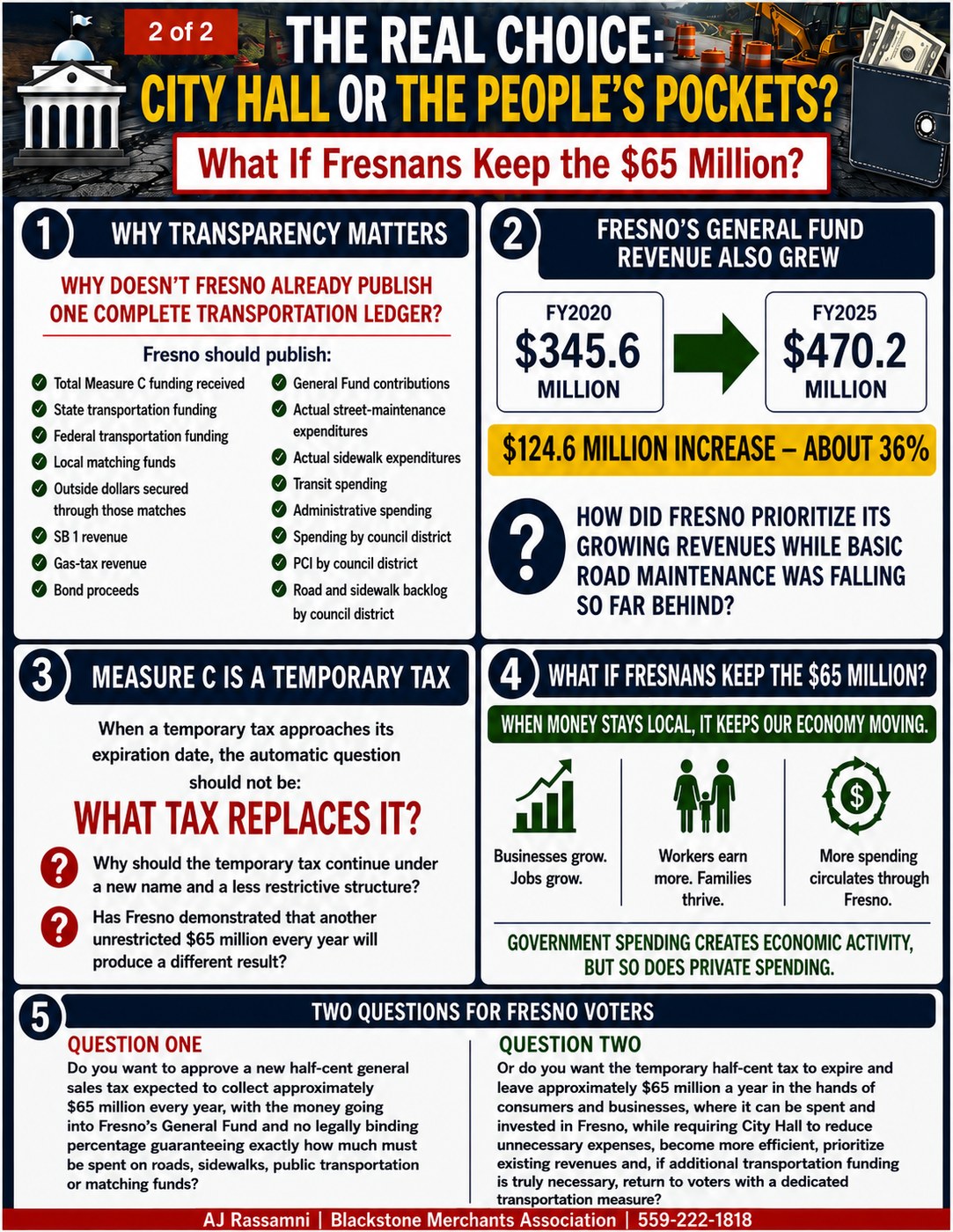
Before asking taxpayers for another $65 million annually, Fresno should release one understandable report showing:
- Total Measure C funding received.
- State transportation funding.
- Federal transportation funding.
- Local matching funds.
- State and federal dollars secured through those matches.
- SB 1 revenue.
- Gas-tax revenue.
- Bond proceeds.
- General Fund contributions.
- Actual street-maintenance expenditures.
- Actual sidewalk expenditures.
- Transit spending.
- Administrative spending.
- Spending by council district.
- PCI by council district.
- Road and sidewalk backlog by council district.
Money in. Money out. Work completed. Results achieved. That is transparency.
Fresno’s General Fund Revenue Also Grew
This is especially relevant because the proposed new tax would go into Fresno’s General Fund.
According to Fresno’s audited financial statements, General Fund revenues increased from approximately $345.6 million in FY2020 to $470.2 million in FY2025. That is an increase of approximately $124.6 million.
So, while Fresno’s infrastructure problem was becoming dramatically more expensive, General Fund revenue also grew substantially. That creates another reasonable question.
How did Fresno prioritize its growing revenues while basic road maintenance was falling so far behind?
Measure C is a Temporary Tax
During the July 30 City Council discussion, Councilmember Annalisa Perea said: “Measure C already accomplished what it was set to do.” That statement deserves consideration. When a temporary tax approaches its expiration date, the automatic question should not be, What tax replaces it?
The questions should be:
Why should the temporary tax continue under a new name with a less restrictive structure?
Has Fresno demonstrated that another unrestricted $65 million every year will produce a different result?
What If Fresnans Keep the $65 Million?
Most of the discussion surrounding the proposed tax focuses on what City Hall would lose. There is another question.
What happens if Fresno’s consumers and businesses keep approximately $65 million a year?
When families have more disposable income, they spend more throughout the local economy.
Those dollars circulate through Fresno restaurants, stores, repair shops, contractors and service businesses.
Government spending creates economic activity, but so does private spending.
If $65 million is important when City Hall receives it, then $65 million is also important when Fresno families and businesses keep it.
Two Questions for Fresno Voters
In the end, voters should ask themselves two questions.
Question One
Do you want to approve a new half-cent general sales tax expected to collect approximately $65 million every year, with the money going into Fresno’s General Fund and no legally binding percentage guaranteeing exactly how much must be spent on roads, sidewalks, public transportation or matching funds?
Question Two
Or do you want the temporary Measure C tax to expire and leave approximately $65 million a year in the hands of consumers and businesses, where it can be spent and invested in Fresno, while requiring City Hall to reduce unnecessary expenses, become more efficient, prioritize existing revenues and, if additional transportation funding is truly necessary, return to voters with a dedicated transportation measure?
That is the choice.
This should not be about Republicans or Democrats. It should be about Accountability before another tax, facts before fear, results before a new tax and, guarantees before promises.
The one-sheet for this op-ed
Print it, post it or share it. 2 pages.